
Volleyball Hand Signals: How to Read the Referee’s Calls
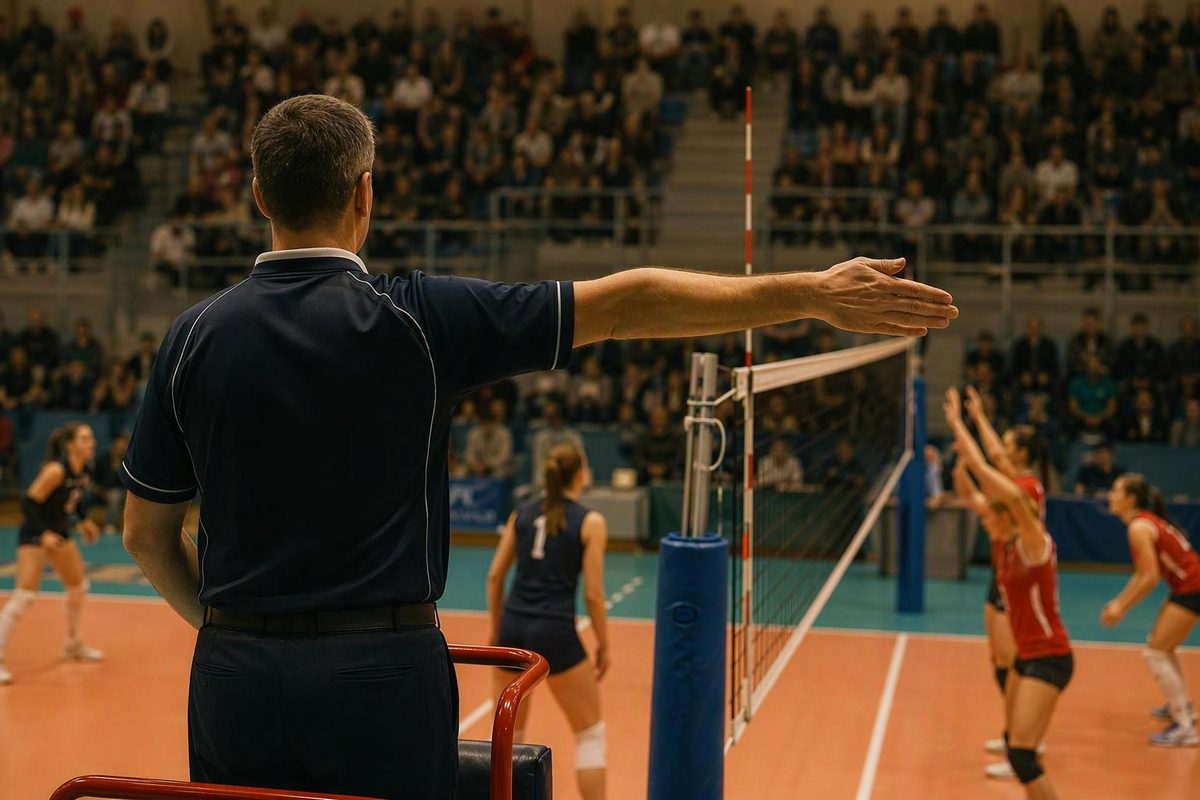
A practical guide to volleyball referee hand signals for points, faults, timeouts, substitutions and line calls, with an example rally.
Volleyball hand signals tell players, scorers and spectators what the referee decided and which team serves next. Under FIVB procedure, an arm extended toward one side identifies the team that will serve; a following gesture may explain why the preceding rally ended. Other rulebooks can use a different order.
The current FIVB indoor rules chart has 25 numbered referee-signal entries, plus five flag signals for line judges. The rules also require a signal to be held briefly; when a one-handed signal identifies a fault or request, the hand corresponds to that team’s side (FIVB Official Volleyball Rules 2025–2028).
Common volleyball referee hand signals
| Gesture | Official meaning | What it tells you |
|---|---|---|
| Hand moves in the direction of service | Authorization to serve | The server may begin the rally. |
| Arm extended toward one team | Team to serve | That team has the next serve. After an ordinary completed rally, it is also the team awarded the point. |
| Hands form a T | Time-out | A time-out has been granted; the referee then indicates the requesting team. |
| Forearms rotate around each other | Substitution | A regular substitution is being processed. Libero replacements are administered differently. |
| Forefinger makes a circle | Positional or rotational fault | A team was improperly positioned or served out of rotation. |
| Arm and fingers point down | Ball in | The ball touched the court, including a boundary line. |
| Forearms rise vertically, palms toward the body | Ball out | The ball landed completely outside the boundary or otherwise met an “out” condition. |
| Forearm rises slowly, palm up | Catch | The ball was caught or thrown rather than rebounding legally. This is often informally called a lift or carry. |
| Two fingers raised | Double contact | One player contacted the ball twice successively when an exception did not apply. It does not mean the team has used two hits. |
| Four fingers raised | Four hits | The team made four contacts before returning the ball. A block contact is treated separately under indoor rules. |
| Hand indicates the relevant side of the net | Net fault | A player illegally contacted the net; the signal also covers a served ball that touches the net between the antennae but does not cross the vertical plane of the net. |
| Both arms straight up, palms forward | Blocking fault or screening | The referee called an illegal block or a serving-team screen. |
| Hand held above the net, palm down | Reaching beyond the net | A player illegally played the ball in the opponent’s space. |
| Open hand makes a downward forearm motion | Attack-hit fault | An illegal attack was completed—for example, one involving a back-row player or libero under the applicable conditions. |
| Point toward the center line or another relevant line | Penetration or service-line fault | This can identify an illegal crossing under the net, a server’s foot fault or a related line violation. |
| Both thumbs raised | Double fault and replay | The rally is replayed; neither team scores from it. |
| One palm brushes the upright fingers of the other hand | Ball touched | A player touched the ball before it went out. |
The full FIVB chart also includes change of courts, end of set or match, improper service release, delay in service, delay sanctions and misconduct cards. USA Volleyball publishes quick-reference pages for indoor officials and beach officials.
How a signal sequence changes the score
Suppose the score is 18–17. Team A attacks, the ball glances off Team B’s block and lands beyond Team B’s end line.
- The whistle ends the rally.
- The first referee extends an arm toward Team A, identifying Team A as the next serving team.
- The referee brushes one palm across the upright fingers of the other hand: ball touched.
- Team A receives the rally point, so the score becomes 19–17, and Team A serves next.
Without the touch signal, an observer might assume the attack simply went out and that Team B should receive the point. The second gesture explains why “out” did not decide the rally. For the underlying point system, see how volleyball scoring works.
Signals that are easy to confuse
- Ball out versus blocking fault: “Out” uses raised forearms with palms facing the referee; a blocking fault uses both arms fully raised with palms facing forward.
- Double contact versus four hits: Two raised fingers concern successive contacts by one player. Four raised fingers concern the team’s contact count.
- Touched versus net contact: Brushing the fingers means the ball touched a player before going out. Indicating the net means a net-related fault.
- Authorization to serve versus team to serve: A sweeping hand starts the rally. An arm held toward one side identifies which team serves.
- Timeout versus challenge: The T-shaped signal means timeout. In NCAA women’s volleyball, a coach requests video review by forming a C with a hand; that competition-specific request is explained in NCAA volleyball challenge rules.
Card combinations also matter. Under FIVB rules, yellow alone is a misconduct warning, red alone is a point-and-service penalty, red and yellow together indicate expulsion for the remainder of the set, and the two cards held separately indicate disqualification for the match. Card consequences can vary by code and context, so identify the competition before interpreting them; see the separate guide to what a red card means in volleyball.
Referee signals and line-judge signals are different
Line judges generally communicate with flags, not the referee’s hand vocabulary. Under the FIVB system:
- flag pointed down: ball in;
- flag raised vertically: ball out;
- raised flag touched at the top by the free hand: ball touched;
- flag waved overhead, followed by pointing to the antenna or line: crossing-space, outside-object or service-position fault;
- arms and flag crossed in front of the chest: judgment impossible.
The first referee makes the final ruling; a line judge’s flag supplies information for that decision.
The order can differ by rulebook
FIVB procedure has the first referee indicate the team to serve, then the nature of the fault and, when needed, the player at fault. If the second referee whistles, that official shows the fault first, while the first referee identifies the team to serve (FIVB rules, Rule 22.2.3).
NCAA women’s mechanics use a different sequence: when the first referee whistles, the result of the play—point or replay—comes before the fault signal. When the second referee whistles, the fault is shown before the first referee indicates the result (2026–27 NCAA Women’s Volleyball Rules, Rule 19.1.5).
Finally, players also use tactical hand signs, particularly partners communicating blocking plans in beach volleyball. Those are team codes, not officiating decisions, and their meanings may vary. When reading a score or ruling, focus on signals from the first referee, second referee and line judges.