
A Red Card Can Change the Score Without Ejecting a Player
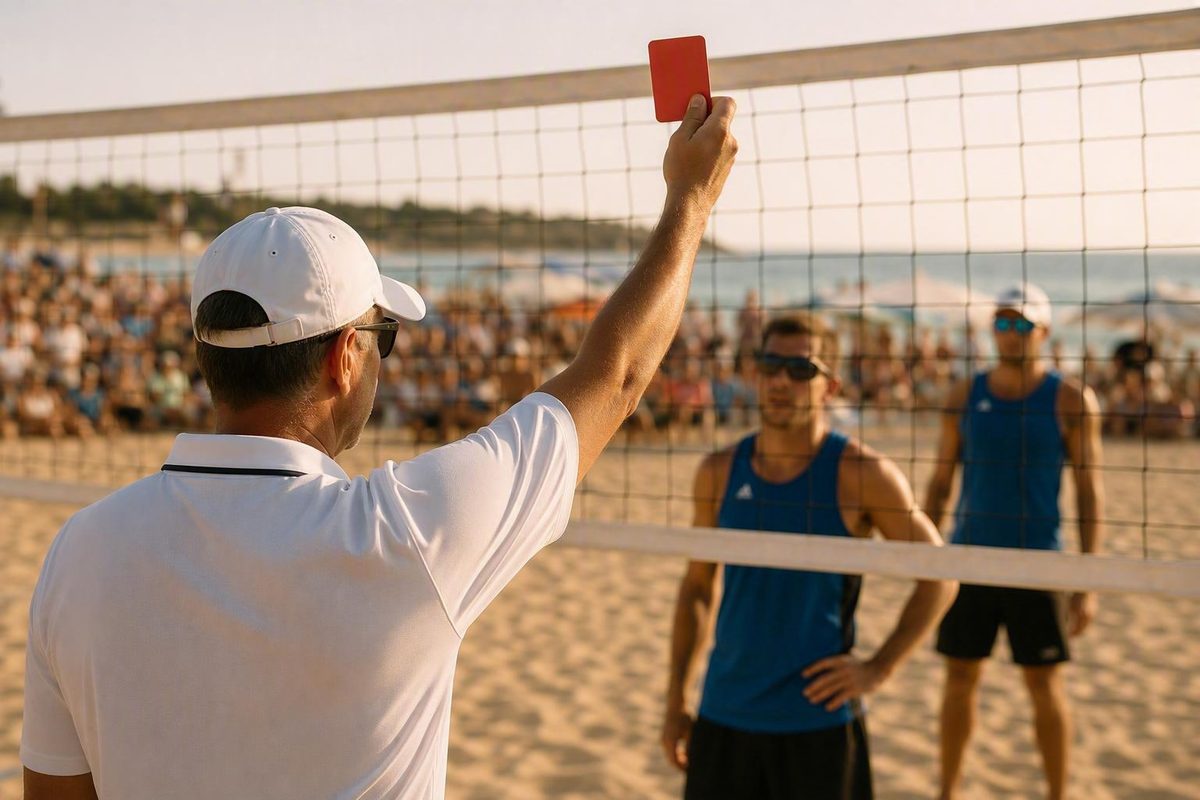
The effect depends on the ruleset and full signal. In the cited beach guide, red alone gives the opponent a point and service.
A volleyball red card does not have one safely universal consequence.
The short answer: check the ruleset and the complete signal
For the clearest supported example, consider the 2020 USA Volleyball beach guide. Its red-card penalty answers three immediate questions:
- Did the score change? Yes. The opponent receives a point.
- Who serves next? The opponent receives service.
- Does red alone mean disqualification? No. The guide uses a different display—red and yellow held apart—for disqualification.
That answer is specific to the dated beach guidance. It should not automatically be transferred to an indoor match, an FIVB event, NCAA competition, an NFHS high-school match, a professional league or a tournament using local modifications.
Before interpreting a referee’s signal, establish:
- Whether the match is indoor or beach volleyball.
- Which organization governs the competition.
- Which rules edition and competition regulations apply.
- Whether the referee showed red alone or displayed yellow as well.
- If both cards appeared, how the referee held them.
Those details separate the scoring consequence from the participant sanction. Seeing red is only part of the information.
What changes on the scoreboard and who serves next
Suppose Team A receives that penalty while the score is tied at 18–18:
| Moment | Team A | Team B | Next serve |
|---|---|---|---|
| Before the penalty | 18 | 18 | — |
| After the penalty | 18 | 19 | Team B |
The service consequence matters because saying only “the other team gets a point” gives an incomplete account of this particular procedure. No assumption is needed about who would otherwise have served; the penalty itself establishes the post-sanction result in the cited guide.
Red alone is different from red and yellow held apart
Card color alone does not communicate the entire ruling. Under the same USA Volleyball beach guide, the referee’s full display distinguishes a standard penalty from disqualification:1
| Referee display | Meaning in the guide | Immediate scoring effect stated |
|---|---|---|
| Red alone | Penalty | Opponent receives a point and service |
| Red and yellow held apart | Disqualification | Not presented as the ordinary red-card penalty |
Red alone therefore should not automatically be described as an ejection or disqualification under this guide. The supported distinction is between a red-card penalty and the separate red-and-yellow disqualification signal. The exact consequences following disqualification can depend on who is sanctioned and the applicable provisions, so “disqualification” is more precise than reducing every case to a generic claim about removal.
The guide also describes escalation. It places limits on repeated penalties and states that further misconduct beyond those limits can result in expulsion for the set. It separately identifies physical aggression or repeated misconduct as grounds for disqualification. These are features of the dated beach procedure, not a universal sanction ladder.
For spectators, the practical lesson is visual: check whether yellow was also displayed and whether the two cards were held apart. Two signals involving red can communicate different rulings.
A red card may address misconduct or delay
A red signal does not necessarily mean the referee observed physical aggression.
In the 2020 beach guide, rude conduct may receive an immediate red-card penalty even when the team has not already received a formal yellow-card warning. A yellow card therefore does not always have to precede red under this procedure.1
The guide also uses red in its delay sequence. It describes a verbal warning followed by a yellow delay warning; a further delay by that team results in a delay penalty indicated by red. The reason for the card may consequently be delay rather than a confrontation between participants.
To understand why the referee showed the card, consider the complete sequence:
- What occurred immediately before play stopped?
- Had the referee already addressed a delay?
- Was the referee communicating with a player, captain or coach?
- Did the referee give another signal indicating delay or misconduct?
- Was yellow displayed with red, and how were the cards held?
The accompanying signals and preceding events are more informative than the color viewed in isolation.
Why indoor, beach and high-school answers should not be blended
Organizations publish separate rules for different disciplines and competition levels. Similar card colors do not, by themselves, prove identical effects on the score, service or participant status.
For current international indoor volleyball, the FIVB Official Volleyball Rules 2025–2028 place misconduct sanctions in Rule 21. The sanction scale is in Rule 21.3, and the summary of misconduct and cards used is in Rule 21.6. The edition applies to competitions beginning after January 1, 2025.2
The corresponding FIVB Official Beach Volleyball Rules 2025–2028 address misconduct in Rule 20. Rule 20.3 contains the sanction scale, while Rule 20.5 covers misconduct and cards used. Those rules were designated for implementation from January 1, 2025.3
Those current FIVB citations establish the applicable editions and where their misconduct provisions are located. They are not used here to claim that red alone currently has the same precise consequence as it did in the 2020 USA Volleyball beach guide. An official ruling should come from the operative provision in the rulebook governing the match.
High-school volleyball illustrates the same need for careful labeling. An NFHS update for 2020–21 stated that a head coach receiving a red card for unsporting conduct had to remain seated for the rest of the match.4 That historical provision does not establish a scoring consequence, and it should not be treated as proof of the current NFHS rule.
When a ruling matters, use this sequence:
- Identify the discipline and governing body.
- Confirm the rules edition and any event-specific modifications.
- Find the applicable misconduct-sanction scale and card summary.
- Match the rule to the referee’s complete display.
- Check the score, next server and participant status as separate questions.
That method avoids importing a dated beach-volleyball consequence into a competition governed by a different rulebook.