
What Does a Yellow Card Mean in Volleyball?
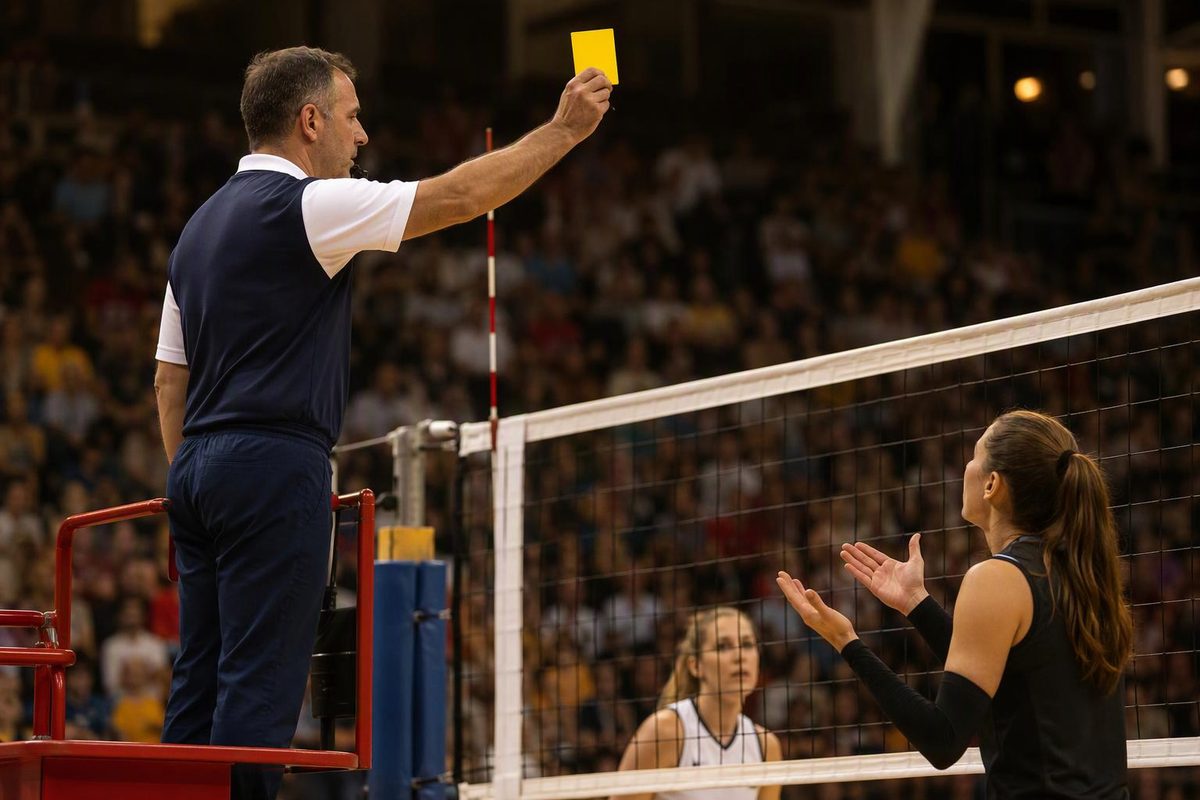
Under FIVB rules, a yellow card is a formal warning, not a lost point. Learn its scoring effect, the delay-warning signal, and how it differs from red.
Under FIVB rules, a yellow card held up alone means a formal misconduct warning—not a point penalty. It does not award the opponent a point, change who serves, or remove the recipient from play. Under the FIVB’s 2025–2028 indoor rules, it is recorded on the scoresheet but has no immediate consequences. It warns the team member—and, by extension, the team—that further misconduct can bring a sanction. FIVB indoor rules, Rule 21.1
The same basic meaning applies under the FIVB beach volleyball rules: yellow alone is a recorded formal warning, with no immediate scoring penalty. The explanation below uses these FIVB rulebooks; for a school, college or local-league match, check the competition’s governing code. FIVB beach rules, Rule 20.1
Why does the referee show yellow?
For minor misconduct, the FIVB indoor rules describe two warning stages:
- Verbal warning: communicated through the game captain.
- Formal warning: a yellow card shown to the team member concerned.
The purpose is to stop conduct from reaching the penalty level. Yellow is not a routine signal for a playing fault such as a net touch or a ball hit out. Nor must every serious incident begin with yellow: offensive conduct or aggression can lead directly to expulsion or disqualification. FIVB indoor rules, Rules 21.1–21.4
What happens to the score?
Suppose Team A leads 18–17 and is due to serve. Before the next rally, one of its players receives a yellow misconduct card.
- The score stays 18–17.
- Team A still serves.
- The player may continue playing.
- The warning is recorded on the scoresheet.
Compare that with a red-card misconduct penalty against Team A at the same score: Team B receives a point and service, making it 18–18 with Team B serving. The point comes from the sanction, not from a played rally. FIVB indoor rules, Rules 21.1 and 21.3.1
Read the full signal, not just the color
Yellow can also appear alongside red. These are the FIVB indoor misconduct signals:
| Referee’s signal | Meaning | Immediate effect |
|---|---|---|
| Yellow alone | Formal warning | No point or removal |
| Red alone | Penalty | Opponent receives a point and service |
| Red and yellow held together | Expulsion | Recipient cannot participate for the rest of the set |
| Red and yellow held separately | Disqualification | Recipient cannot participate for the rest of the match |
These meanings come from FIVB indoor Rules 21.3 and 21.6. For more on the scoring sanction, see what a red card means in volleyball.
Do not apply a “two yellows automatically mean a sending-off” rule. FIVB volleyball uses a misconduct sanction scale based on the offense and its repetition, rather than that shortcut. FIVB indoor rules, Rule 21.4
Yellow against the wrist means a delay warning
There is a separate yellow-card signal: the referee covers the wrist with the card to indicate a delay warning. This concerns delaying the game—for example, prolonging an interruption after being told to resume—not the misconduct warning above.
Under FIVB indoor rules, the first team delay receives a warning with no point penalty. A second or subsequent delay by any member of that same team during the match gives the opponent a point and service. The delay record does not reset between sets. A delay penalty is signaled with a red card against the wrist. FIVB indoor Rule 16.2 and Diagram 11, signal 25