
How Video Challenges Work in 2026 Women’s College Volleyball
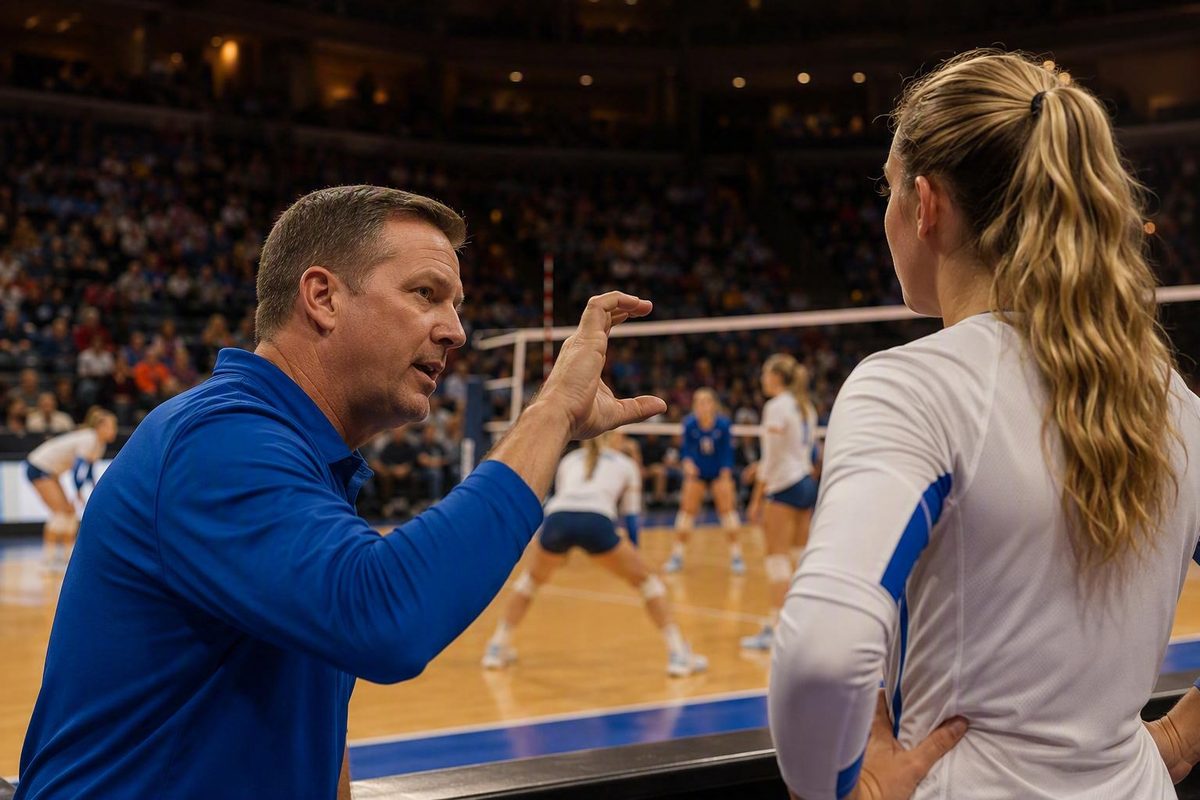
Coaches request review with a hand-formed “C” before a timeout. They begin with two challenges, retain successful ones and lose them when rulings stand.
In an NCAA women’s volleyball match using the Challenge Review System (CRS), the head coach requests review with a hand-formed “C” before initiating a timeout. Each head coach begins with two challenges. Indisputable video evidence is required to reverse a ruling; a reversal lets the team retain its challenge, while an unchanged ruling—including one left in place because the video is inconclusive—costs the challenge.
The defining 2026 addition makes it a fault when one or both feet completely cross the center line and contact the opponent’s court. That decision is reviewable, and officials may examine a possible net fault during the same review.
The 2026 challenge rules at a glance
These confirmed provisions govern NCAA women’s volleyball in the 2026 and 2027 seasons, not NCAA men’s volleyball. CRS is not described as universal at every women’s match; participating conferences or institutions that choose to use it must follow the applicable guidelines.
The final changes were approved on February 19, 2026, by the Division I Women’s Volleyball Oversight Committee and the Divisions II and III Playing Rules Oversight Panel. They took effect for the 2026 and 2027 seasons, according to the NCAA’s final approval announcement.
| Rule or procedure | 2026 requirement | Practical effect |
|---|---|---|
| Request signal | The head coach forms a hand-shaped “C” | A physical challenge card is no longer required |
| Request timing | The request must be made before a timeout is initiated | A coach cannot initiate a timeout and then decide to challenge |
| Reversal standard | Video must provide indisputable evidence that the ruling was incorrect | Unclear video cannot overturn the decision |
| Successful challenge | The ruling is reversed and the challenge is retained | The team’s available-challenge count does not decrease |
| Unsuccessful or inconclusive challenge | The ruling stands and the challenge is lost | Failure to overturn costs one available challenge |
| Fifth set | Each team receives another challenge, capped at two available | No team begins the deciding set with more than two |
| Center-line review | A complete foot crossing onto the opponent’s court is reviewable | Coaches can challenge the new center-line-foot fault |
| Related net contact | Officials may examine a possible net fault during that review | One review can resolve the connected center-line and net questions |
| Timeouts | Challenges do not reduce the timeout allowance | The two resources are tracked separately |
The January 8 report described proposals rather than operative rules. The February approval converted the relevant recommendations into rules for the two-season cycle.
How many challenges a team gets—and when one is retained
Each head coach starts the match with two challenges. That is the number of available coach-initiated challenges, not necessarily the maximum number of reviews a coach can request: when a challenge produces a reversal, the team retains it and may use it again. These allowance and outcome rules are set out in the 2026 CRS guidance.
| Review outcome | Ruling after review | Effect on allowance |
|---|---|---|
| Indisputable evidence shows the original ruling was wrong | Ruling is reversed | Challenge retained |
| Video does not justify a reversal | Original ruling stands | Challenge lost |
| Video is inconclusive | Original ruling stands | Challenge lost |
| A reversal requires the rally to be replayed | Rally is replayed | Challenge retained |
A replay does not create a separate challenge-allocation rule. If indisputable evidence reverses the original ruling and the prescribed result is a replay, the successful challenge is retained. If the original ruling remains unchanged, the challenge is lost.
It is also important to distinguish “the call was shown to be correct” from “the call could not be overturned.” Inconclusive video means the available footage did not provide indisputable evidence that the ruling was incorrect. It does not prove that the on-court ruling was factually correct.
If the match reaches a fifth set, each team receives an additional challenge, subject to a maximum of two available challenges. A team entering set five with one challenge rises to two. A team already holding two remains at two rather than increasing to three.
Challenges and timeouts are separate resources. Requesting or losing a challenge does not reduce the number of team timeouts.
The challenge sequence from signal to decision
A coach-initiated review follows five practical steps:
- The head coach requests review. At the end of the relevant play, the head coach makes the hand-formed “C.” Officials who need the exact signal mechanic should follow the controlling CRS Manual.
- The second referee clarifies the request. The referee confirms which decision the coach wants reviewed.
- Reviewability is established. Officials determine whether the disputed decision belongs to a reviewable category.
- The available video is examined. The second referee uses the relevant available angles to evaluate the original decision.
- The review is resolved. The ruling remains unchanged, is reversed, or is reversed with a replay when that is the required result.
A reversal is permitted only when the video provides indisputable evidence that the original ruling was incorrect. If the video is inconclusive, the ruling stands and the challenging team loses the challenge.
The decision flow is:
Reviewable issue → video review → indisputable evidence? Yes: reverse the ruling, retain the challenge and apply the required result, including a replay where appropriate. No: leave the ruling unchanged and charge the challenge.
A successful review should not automatically be described as awarding a point. The consequence depends on the play under review, and some reversals require another rally instead.
The initial reviewability check is therefore consequential. CRS is not a general mechanism for reconsidering every judgment made during a rally; it covers specified decisions.
Which calls can be challenged in 2026
The categories below are those identified in the 2026 CRS guidance. They provide a practical map of reviewable decisions but do not replace Rule 18 or the complete CRS Manual. The guidance identifies ball-location, player-contact, net and line decisions as reviewable in the circumstances described.
| Category | Decisions identified as reviewable | Typical question |
|---|---|---|
| Ball location | In or out, including pancakes and antenna decisions | Did the ball touch the floor, boundary or antenna as ruled? |
| Player contact | Four hits, double contact, and specified illegal attack, illegal block or over-the-opponent’s-court decisions dependent on contact | Did the relevant player contact the ball? |
| Net and attack line | Player net faults; attack-line faults by a back-row attacker or a libero setting in the front zone | Did the player touch the net or violate an attack-line restriction? |
| Center and service lines | Center-line faults and service-line foot faults | Did the player completely cross the center line with a foot, or did the server commit a line fault? |
These categories have scope limits. An illegal attack, illegal block or over-the-opponent’s-court decision may be reviewed when the question depends on whether an involved player contacted the ball. That does not make every judgment associated with those plays reviewable.
A pancake falls under in-or-out review because the decisive issue is ordinarily whether the ball contacted the floor before the defender kept it in play. An antenna decision similarly uses video to determine the ball’s path or contact relative to the antenna.
The new center-line challenge, with court examples
Under Rule 15.2.4.3, a center-line-foot fault occurs when a player completely crosses the center line and contacts the opponent’s court with one or both feet. Rule 18.1.4.7 makes that decision challengeable and permits officials to examine a possible net fault during the same review, as confirmed in the 2026 and 2027 NCAA women’s rules book.
Both parts of the center-line standard matter. The foot must be completely across the line, and it must contact the opponent’s court. A shoe touching the center line—or remaining partly on or above it—does not satisfy the complete-crossing requirement. The test concerns the whole foot, not whether the toes or most of the shoe extend beyond the line.
The foot rule also should not be expanded to every body part. A player may completely cross the center line with another body part if the action does not interfere with an opponent. A hand, knee or another body part entering the opponent’s side is therefore not automatically a fault.
Example 1 — Legal line contact: A blocker lands with most of one shoe beyond the center line, but the heel remains on or above the line. Because the foot has not completely crossed, the play does not meet the complete-foot fault standard.
Example 2 — Center-line fault: A hitter lands with the entire shoe beyond the center line and in contact with the opponent’s court. The complete crossing and court contact establish the foot-based fault.
Example 3 — Center-line and possible net contact: A coach challenges whether an opponent’s entire foot crossed. While reviewing the video, officials identify possible contact with the net. They may examine that possible net fault as part of the same center-line review.
The change replaced the previous standard described during the proposal stage. Under that earlier standard, a foot completely crossing the center line was not by itself a fault unless the crossing caused interference or created a safety hazard. The NCAA’s January 8 proposal account documents that former rule and the rationale for recommending a more objective standard.
An independent overview of the 2026 NCAA volleyball changes identifies the full-foot center-line rule as the headline change for fall 2026. The official NCAA women’s rules book controls the rule’s exact application.
Timing, timeouts, and scoring corrections
A challenge must be requested before a timeout is initiated. For Division I, the 2026 major-rules-change summary also says that the head coach must make the request immediately after the relevant play. The same document authorizes referees to consult official match statistics or CRS when resolving a scoring discrepancy without requiring a coach’s protest, as detailed in the Division I rules-change summary.
A valid sequence is straightforward: the play ends, the head coach immediately forms the “C,” and only afterward addresses any timeout need. The late sequence reverses those actions: the coach initiates a timeout and then seeks review. Once the timeout has been initiated, the coach may not challenge the preceding decision.
The cited rules materials do not define the precise whistle, signal or administrative act that constitutes initiation of a timeout. Coaches should not test that boundary; the practical approach is to signal the challenge first.
At the proposal stage, the committees said the cutoff was intended to prevent a team from using a timeout to gain extra deliberation time before deciding whether to request review. That rationale appears in the January 8 NCAA proposal announcement.
A scoring correction is different from a coach-initiated challenge. Referees may consult the official match statistics or use CRS to resolve a scoring discrepancy without a coach lodging a protest. That action does not give either team another challenge or turn the correction into a charged coach request.
A scoring discrepancy exists when a recorded or displayed score does not reflect the actual result of play. If a displayed or recorded score conflicts with the actual result recorded on the official scoresheet, the official scoresheet controls under the NCAA women’s rules book.
Scope, adoption timeline, and official rule resources
The adoption sequence separates the recommendation from the final rule:
- January 8, 2026: The women’s rules committees published their proposed center-line and challenge-procedure changes.
- February 19, 2026: The appropriate NCAA oversight bodies approved the changes.
- 2026 and 2027 seasons: The approved women’s rules apply.
NCAA maintains separate women’s major-rules-change documents for Division I and for Divisions II and III. Coaches, officials and match administrators should therefore consult the document for their division rather than assume that every administrative detail is identical.
NCAA men’s volleyball is governed separately. The NCAA publishes a 2025-27 National Collegiate men’s rule book and 2026-27 men’s modifications, but the supplied men’s resource page does not itself establish a video-challenge procedure. The women’s CRS rules described here should not be transferred to men’s competition.
The official NCAA women’s playing-rules page provides the rule book, separate division-level major-change documents and the 2026-27 Challenge Review System Manual. Those controlling materials should be used for complete procedures, signal mechanics and match-administration requirements.
The courtside takeaway is simple: in a 2026 NCAA women’s match using CRS, the head coach should identify a reviewable decision and form the “C” immediately, before initiating a timeout. The defining new review concerns a foot completely crossing the center line and contacting the opponent’s court, with a possible net fault examinable during the same review. Anyone responsible for administering a match should verify the applicable division-specific details in the official rule book and CRS Manual.