
When Stepping Under the Net Becomes a Fault
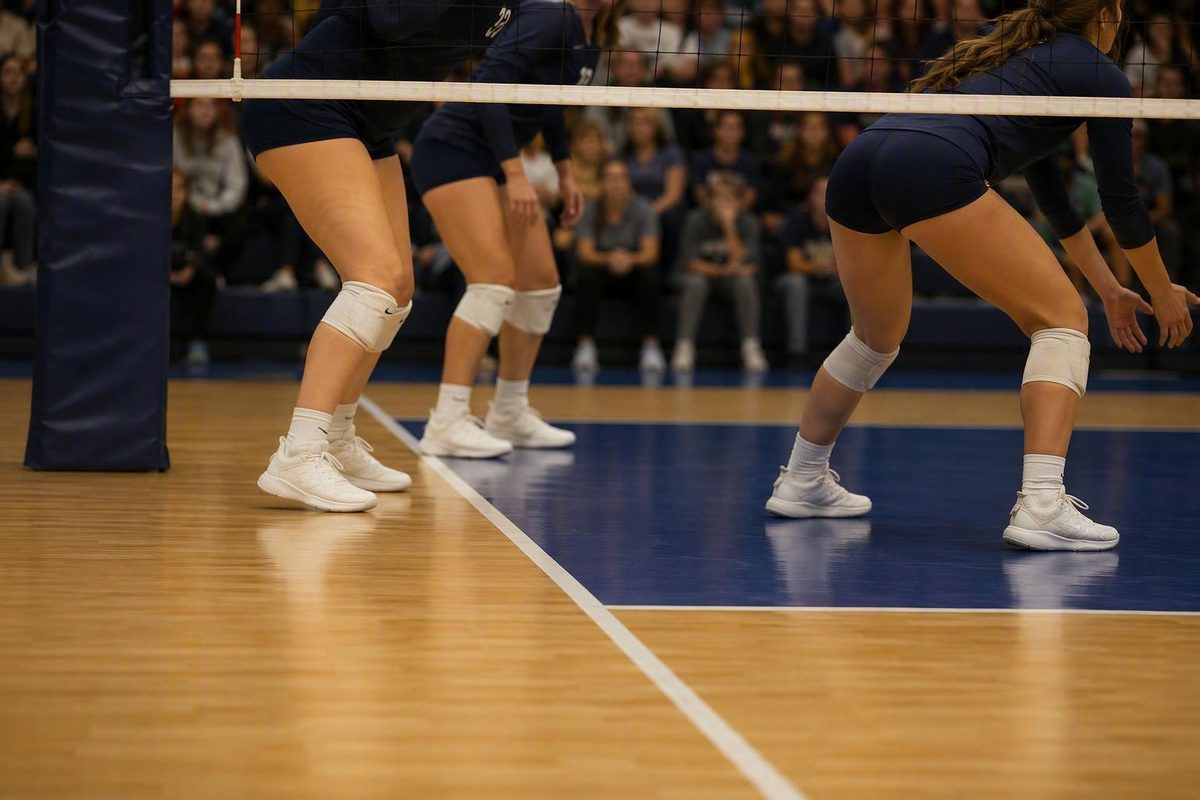
Under NCAA women’s rules, a foot entirely beyond the line is a fault without interference or danger; partial crossings and other rules need separate checks.
Beginning with the 2026 NCAA women’s volleyball season, a player commits a center-line fault when her foot crosses completely beyond the center line. Officials do not also need to find that she interfered with an opponent or created a safety hazard—the complete crossing itself is sufficient under the NCAA’s approved 2026 rule change. This is an NCAA women’s indoor standard, not a universal rule for every volleyball competition.
Related: How Volleyball Scoring Works.
The short answer for 2026 NCAA women’s volleyball
The practical test is straightforward:
If the player’s entire foot is beyond the center line, it is a fault.
For this specific situation, the official does not need to make a second finding about interference or danger. Once the foot has crossed completely, the confirmed 2026 NCAA women’s threshold has been met.
The Division I Women’s Volleyball Oversight Committee and the Divisions II and III Playing Rules Oversight Panel approved the change for the 2026 season. The approval also made center-line calls challengeable and allowed officials reviewing such a challenge to examine a possible net fault on the same play.
The wording matters. The published NCAA material establishes the threshold for a foot that completely crosses the line. It is not a comprehensive explanation of how the rule applies to a hand, knee, leg or another body part. It also does not fully resolve every position in which only part of a foot extends beyond the line.
That means three questions should remain separate when interpreting a play:
- Was the action governed by 2026 NCAA women’s volleyball rules?
- Did the player’s entire foot cross beyond the center line?
- Does the play instead involve a partial crossing, another body part or a different type of fault?
Only the first two questions are answered by the complete-foot standard discussed here. The rule should not be expanded beyond what the published NCAA summary establishes.
Do not automatically apply this test to NFHS high school, USA Volleyball, NCAA men’s, international or beach competition. Similar court markings do not guarantee identical center-line rules.
How to read the foot’s position against the line
A center-line decision depends on more than whether a player appeared to step “over” a narrow mark. The line has measurable width and is part of both courts.
Under the FIVB court definition, court lines are 5 centimeters wide. The center line extends beneath the net from side line to side line, and its entire width belongs equally to both courts. This definition establishes the line’s dimensions and placement; it does not, by itself, provide the complete rule for penetration under the net.
Shared ownership of the line is important when describing the position of a foot. A foot touching the center line is not, on that fact alone, entirely beyond it. Likewise, the everyday phrase “over the line” can describe several materially different positions.
| Foot position | What can be concluded |
|---|---|
| Foot entirely beyond the line | Fault under the 2026 NCAA women’s rule. |
| Foot touching the line | Line contact by itself is not the same as the foot being completely beyond the line. |
| Foot partly beyond the line | Not comprehensively established by the published NCAA summary; consult the current NCAA rulebook or match officials. |
The first row provides the confirmed decision point. If no part of the foot remains on or above the center line and the foot is completely in the opponent’s court, the 2026 NCAA women’s complete-crossing threshold applies.
The second row is deliberately narrower. Saying that line contact is not the same as complete crossing does not establish a universal ruling for every step that touches the line. It identifies only why “touching” and “completely beyond” should not be treated as interchangeable descriptions.
The third row also requires restraint. A toe might extend beyond the far edge while the heel remains above the line, or most of the foot might appear across without being entirely beyond it. The available NCAA summary does not comprehensively resolve those partial-foot positions. They should not be declared legal or illegal solely by extrapolating from the complete-foot provision.
For coaches, spectators and players, precise language helps. Instead of saying only that a player was “over,” describe whether the foot touched the line, partly extended beyond it or landed completely past it. Video review may turn on that distinction.
The rule also should not be stretched into a comprehensive standard for every movement beneath the net. A foot-crossing decision, possible opponent interference and possible net contact are related only when the facts of the play bring each issue into consideration.
What changed from the previous NCAA standard
The 2026 change removed an additional judgment from one specific situation: a foot that has completely crossed the center line.
| NCAA women’s standard | Completely crossed foot |
|---|---|
| Before 2026 | Not a fault unless the player caused interference or created a safety hazard |
| From 2026 | A fault without an additional finding of interference or a safety hazard |
Before the change, seeing an entire foot beyond the line did not finish the analysis. The official still had to evaluate whether the player interfered with an opponent or created a safety hazard. Complete crossing supplied the physical fact, but the effect or danger of the action remained part of the ruling.
Beginning in 2026, the complete crossing is itself enough for this foot-crossing situation. The new standard therefore replaces a more judgment-dependent test with an observable positional threshold. A VolleyballMag explanation of the change similarly distinguishes the new complete-foot rule from the former interference-and-safety test.
This does not mean judgment has disappeared from every center-line play. Officials may still need to determine whether the foot actually cleared the entire width of the line, and the published NCAA summary does not comprehensively address partial crossings or other body parts. The change is specific: it eliminates the need for an additional interference or safety finding after a foot has crossed completely.
The rule also moved through two distinct procedural stages. On January 8, 2026, NCAA women’s volleyball rules groups proposed the complete-foot standard. That announcement stated that the recommendations still required approval through the NCAA governance structure. The relevant Division I and Divisions II/III oversight bodies subsequently approved the change for the 2026 season.
Distinguishing those stages prevents a proposal from being mistaken for an adopted rule. The January announcement described what the committees recommended; the later approval established what would govern play beginning with the 2026 season.
The NCAA said the change brings women’s volleyball more in line with the international center-line standard. That describes the direction of the revision, not complete identity between NCAA and FIVB provisions. The available FIVB court excerpt establishes the center line’s dimensions and shared ownership, but it should not be treated as a complete statement of every international penetration rule.
How a center-line challenge works
Under the 2026 NCAA women’s rule, a coach may challenge whether an opponent’s foot completely crossed the center line. The confirmed review process can be understood as a short two-step workflow:
- Review the challenged center-line question: Did the opponent’s foot cross completely beyond the center line?
- Check for a related net fault: While reviewing that play, officials may also examine a possible net fault.
The central challenge question is positional. Officials are determining whether the entire foot crossed, not merely whether part of it touched or extended over the line. That distinction matches the threshold used to define the confirmed fault.
The ability to examine a possible net fault does not merge the two rules. Center-line penetration concerns the player’s position relative to the line and the opponent’s court. A net fault concerns contact with the net under the applicable standard. One sequence may produce evidence relevant to both, but proof of one does not automatically establish the other.
For example, video might show that a foot did not cross completely while also revealing possible net contact. Conversely, it could establish a complete-foot crossing without showing a net fault. The review may cover both questions, but each must be evaluated as its own type of action.
The published NCAA summary does not provide support for additional assumptions about challenge deadlines, challenge limits, costs, required camera angles, video-quality standards or procedural consequences. Those details should come from the current NCAA playing rules and the procedures governing the particular match.
Why the competition’s rule set still matters
No, the 2026 NCAA women’s complete-foot standard is not automatically the center-line rule at every level of volleyball. Before interpreting a call, identify the governing organization, discipline, gender category and season.
As a limited contrast, a 2024 USA Volleyball spectator quick guide says a player may enter the opponent’s court when some part of the body remains on or above the center line and there is no interference. It also says a body part crossing completely may not present a safety hazard to opponents.
That document is a spectator guide, not the complete current USA Volleyball rulebook. It should therefore be used only to illustrate why a rule familiar from one competition cannot automatically be imposed on another. Its summary retains interference and safety considerations, while the confirmed 2026 NCAA women’s rule makes a completely crossed foot a fault without requiring either additional finding.
The same caution applies when moving among NCAA women’s, NCAA men’s, NFHS high school, USA Volleyball, FIVB or beach events. This article’s evidence does not establish the complete current center-line standard for all those competitions. A referee, coach or spectator should consult the rulebook and interpretations governing the event rather than assuming that one organization’s test controls everywhere.
Season matters as well as organization. A correct description of the NCAA women’s rule before 2026 would be incorrect for the same complete-foot situation beginning in 2026. When reviewing older clips, discussions or officiating materials, check which season’s standard was in effect.
When was the 2026 NCAA women’s rule set first used in live competition?
The first live competition under the 2026 NCAA women’s volleyball rule set was the AVCA First Serve event, held August 21–24, 2026, at Fiserv Forum in Milwaukee, according to the NCAA’s 2026 season-opening guide.
What signal does an official use for penetration into the opponent’s court?
USA Volleyball’s indoor officiating resource shows the official pointing to the center line or other applicable line for penetration into the opponent’s court. The gesture communicates the ruling; it does not define the substantive conditions that make the action a fault.
For 2026 NCAA women’s volleyball, the usable test remains narrow and clear: a foot entirely beyond the center line is a fault even without interference or danger. For a partial crossing, another body part or another level of play, consult that competition’s current official rules rather than treating the NCAA women’s standard as universal.