
What the Longest Documented Volleyball Rallies Actually Measure
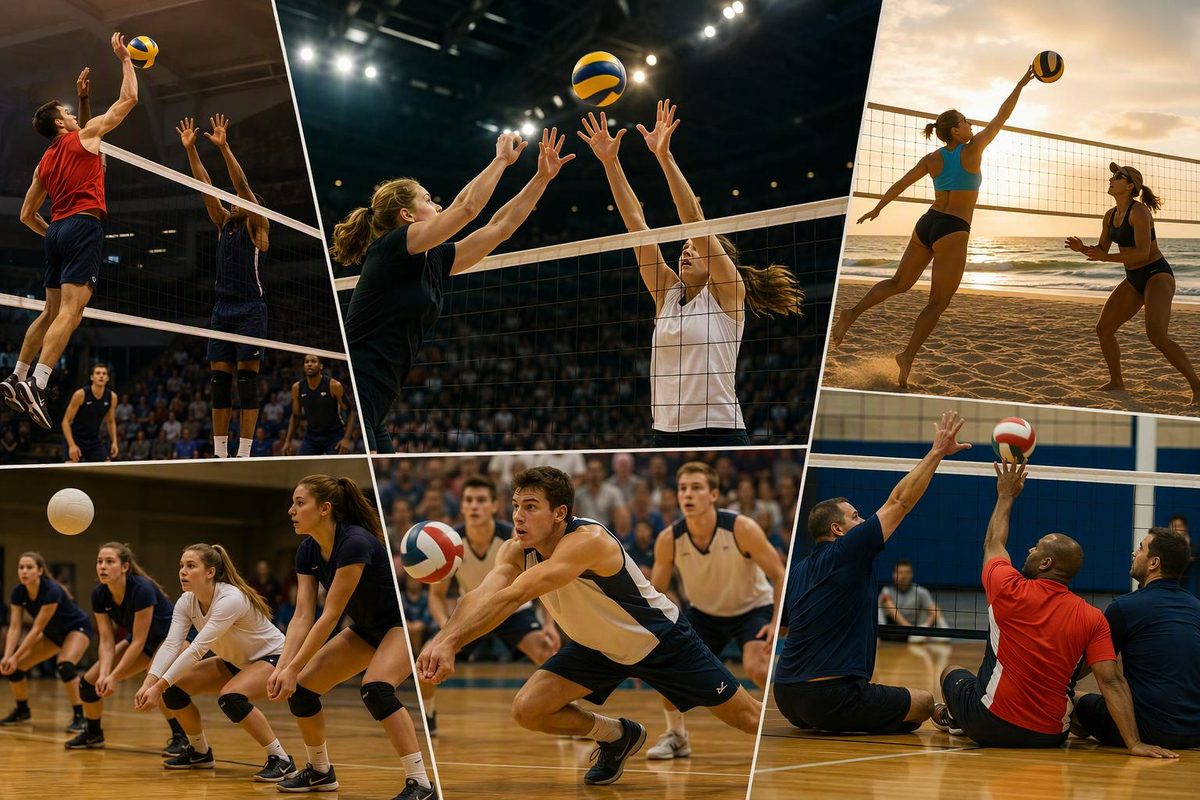
Compare USA Volleyball’s 2:04 rally with NCAA, junior, beach and sitting-volleyball examples, and see why time, contacts and passes give different answers.
The longest timed rally in USA Volleyball’s published collection is 2 minutes, 4 seconds, listed as “China Pro,” from 2012. The federation gives 30 net crossings and 78 total contacts for that indoor exchange. It is a documented benchmark, not proof of an all-time world record: USA Volleyball describes its page as a ranking of recorded rallies and invites further discoveries. Source: USA Volleyball
The answer changes if “longest” means the most contacts rather than the most elapsed playing time. A sitting-volleyball record measured in passes belongs to another category again. Those distinctions determine which examples can reasonably be compared—and which record claims the available evidence supports.
Choose time, contacts or passes to compare the published examples on the same measure.
Compare Rally Measures
This leads USA Volleyball’s timed collection, not a verified worldwide ranking. The table includes other measurement categories for context.
| Example | Time | Contacts | Passes |
|---|---|---|---|
| China Pro Indoor · 2012 | 2:04 | 78 | — |
| North Texas College · 2019 | 1:55 | — | — |
| West Florida vs. Miami Wave Junior · 2022 | ~1:50 | — | — |
| Victory Elite vs. Xtreme Indoor · 2013 | 1:33 | 82 | — |
| USA vs. Canada Beach, age group 21 · 2016 | 1:07 | — | — |
| Great Britain squad Sitting · 2011 | — | — | 239 |
Sources: USA Volleyball rally listings, NCAA top plays and Guinness World Records. ~ means approximate; — means not supplied in the evidence used here.
Category Limits and Source Links
China Pro also has 30 listed net crossings; its clubs and exact match date are not identified. The NCAA example is a top play, not a stated NCAA record. The junior clip runs 1:59, but its rally is described as approximately 1:50. The beach entry is an age-group highlight, not an established all-time beach record.
The 239-pass sitting-volleyball attempt took place in Trafalgar Square on September 8, 2011, celebrating International Paralympics Day. It was staged, not presented as a competitive match point.
USA Volleyball collection · NCAA top plays · Junior rally · Guinness sitting record
The 2:04 Listing Is a Benchmark, Not a Universal Record
USA Volleyball’s “China Pro” entry identifies the rally by that label and the year 2012. It does not name the two clubs or give an exact match date. The defensible description is therefore a 2:04 indoor rally listed by USA Volleyball, not a specific fixture reconstructed from an unidentified video.
The source’s scope also limits the claim. A collection of recorded rallies can establish which entry has the greatest published duration within that collection. It cannot, by itself, establish that no longer rally has occurred in an unrecorded match, an unpublished recording or another competition.
That is why “longest recorded rally in USA Volleyball’s collection” is more precise than “longest volleyball rally ever.” The former identifies both the measurement and the evidence set. The latter would require a worldwide record claim that this source does not make.
The accompanying figures—30 net crossings and 78 total contacts—describe the same exchange in different ways. They are not alternative expressions of 2:04. Time measures duration; contacts count touches; net crossings count exchanges across the net. A rally can lead one of those measures without leading the others.
Published Examples Span Different Competitions
These are selected published examples, not a comprehensive world ranking. The source identification is kept as narrow as the available listing allows.
| Setting | Published Example | Year | Rally Time |
|---|---|---|---|
| Adult indoor | “China Pro” | 2012 | 2:04 |
| College women’s indoor | North Texas rally | 2019 | 1:55 |
| Junior indoor, 14 American | West Florida 14 Club Rox vs. Miami Wave U14 Aqua Mizuno | 2022 | ~1:50 |
| Indoor | Victory Elite Black vs. Xtreme 17 Keapa | 2013 | 1:33 |
| Beach, age group 21 | USA vs. Canada | 2016 | 1:07 |
The China Pro, Victory Elite and beach examples come from USA Volleyball’s longest-rallies collection. The 1:55 North Texas exchange appears in an NCAA women’s volleyball top-plays video. The NCAA calls it a top play; it does not label it an NCAA rally-duration record. “A published college example” is supported. “The longest rally in NCAA history” is not established by that description.
The junior exchange appears in USA Volleyball’s Sunshine Classic video listing, which describes the rally as approximately 1:50. That approximation should survive any comparison. Displaying it as an exact time would make the evidence look more precise than the source provides.
The beach example is identified as USA vs. Canada, age group 21, in 2016, with a listed duration of 1:07. It should not be promoted from a listed highlight to an all-time beach record. Nor should its age-group identification disappear when the rally is cited: the listing does not establish a record for every level of beach competition.
Within these selected examples, the published times place China Pro first. That ordering is useful for comparing the entries, but it does not turn the table into a worldwide leaderboard. A table can be accurate while remaining incomplete.
Rally Time Runs From the Service Hit to the End of Play
Under the FIVB 2025–2028 indoor rules, a rally begins with the server’s service hit and ends when the ball is out of play. The ball is out of play at the moment of a fault subsequently whistled by a referee or, in the absence of a fault, at the whistle. These definitions appear in Rules 6.1.3 and 8.1–8.2.
Pre-serve preparation is outside that interval. So are celebrations after the point and any replay of the exchange. A video’s running time is therefore not automatically a rally’s playing time, even when the upload contains only one featured point.
The Sunshine Classic example makes that distinction concrete. USA Volleyball’s player shows a 1:59 clip, while the description puts the actual rally at approximately 1:50. Reporting the whole upload as the rally duration would overstate the exchange and discard the source’s own timing description.
A comparison needs consistent start and end events. Starting one timer during service preparation and another at ball contact does not measure the same interval. Ending at a celebration instead of the end of play creates the same problem at the other end. The rules provide a definition for an indoor rally; the video evidence must still show the relevant events clearly enough to apply it.
The supplied listings do not provide a shared, detailed timing protocol for every entry. Their published durations should consequently remain attributed to their sources, rather than presented as independently remeasured results. The FIVB definition explains what rally time means; it does not retroactively certify the timing method used for each historical clip.
More Contacts Do Not Necessarily Mean More Seconds
USA Volleyball lists Victory Elite Black vs. Xtreme 17 Keapa in 2013 at 1:33 with 82 contacts. That is more contacts than the 78 listed for the longer 2:04 China Pro exchange. These two entries directly show why “longest by time” and “most touches” are different claims.
| Indoor Example | Rally Time | Total Contacts |
|---|---|---|
| China Pro, 2012 | 2:04 | 78 |
| Victory Elite vs. Xtreme, 2013 | 1:33 | 82 |
Elapsed time includes the ball’s movement between contacts. A contact count records touches without describing how long those intervals last. Neither figure can substitute for the other, and a duration alone is not enough to reconstruct the number of contacts.
The source also lists 30 net crossings for China Pro. That figure cannot be treated as 30 total contacts: teams can make multiple contacts before returning the ball across the net. Conversely, the 78-contact total does not mean the ball crossed the net 78 times.
For the other timed examples in the comparison, the supplied evidence does not give contact totals. Those values remain unknown. A missing figure is not zero, and it is not a reason to estimate a count from the video duration. The comparison tool therefore shows a dash rather than assigning a contact total to North Texas, the Sunshine Classic rally or the beach exchange.
Among the examples here with a published contact count, Victory Elite leads. That is a narrower statement than a contact-count world record, just as China Pro’s leading time is narrower than an all-time duration record.
A Two-Minute Rally Still Earns One Point
The three-hit limit does not apply to the entire rally. Under FIVB 2025–2028 indoor Rule 9.1, each team has up to three hits, in addition to blocking, to return the ball. That allowance applies to a team’s return of the ball, not to all the touches accumulated by both teams throughout the exchange.
The teams can keep exchanging legal returns. These rules impose no overall rally-duration cap. A long contact total is therefore not, on its own, evidence that the three-hit rule has been broken. The relevant question is how each team handles the ball before returning it, not how many touches the complete point contains.
Under Rule 6.1.3, winning a rally earns one point regardless of its length. A two-minute exchange does not earn extra points, and a short service-error rally is not worth less. Duration and scoring value are separate quantities.
For example, in one of the first four FIVB indoor sets tied 24–24, Team A could win a two-minute rally and lead 25–24. It has not yet won the set because it still needs a two-point lead. Winning the next rally—even a very short one—would finish the set 26–24.
Under Rules 6.2 and 6.3.2, those sets are played to 25 with a two-point minimum lead. The deciding fifth set is played to 15, also with a two-point minimum lead. The duration of either rally in the example does not alter those requirements.
That is the essential rally-scoring distinction: a longer exchange changes the amount of play required to resolve the point, not the point’s value. A long match or high-scoring set is a different record category. It concerns the accumulation of points or the duration of a larger contest, rather than one uninterrupted exchange.
The Guinness Sitting-Volleyball Record Counts Passes
Guinness World Records lists a 239-pass sitting-volleyball rally, achieved by the Great Britain men’s sitting volleyball squad in Trafalgar Square, London, on September 8, 2011. The staged attempt celebrated International Paralympics Day and involved squad and club players. Source: Guinness World Records
That record is measured in passes, not seconds. The supplied evidence does not give a duration that can be placed alongside China Pro’s 2:04. Converting the pass total into minutes would require timing evidence that is not present here.
It was also not presented as a competitive match point. A staged attempt to sustain an exchange and a contested rally in a match have different purposes. Both can produce documented achievements, but they do not answer exactly the same record question.
The Guinness designation applies to the sitting-volleyball category named by its source. It does not make 239 passes the duration record for standing indoor volleyball or beach volleyball. Nor does China Pro’s longer published time displace a record whose stated unit is passes.
The Strongest Claim Names the Measure and the Source
For a time-based answer, use “USA Volleyball lists a 2:04 China Pro rally from 2012 as the longest timed entry in its collection.” That wording preserves the useful number without claiming a universal record the source does not establish.
For contacts, the selected evidence gives a different leader: 82 contacts for Victory Elite Black vs. Xtreme 17 Keapa, compared with China Pro’s 78. For the Guinness sitting-volleyball category, the documented achievement is 239 passes, not a published elapsed time.
Keep the competition setting attached to each figure, retain the approximation on the junior rally, and distinguish upload length from playing time. Those details are what make the answer defensible: the largest number is only meaningful when its unit, category and evidence are clear.