
Who Is Tallest Depends on the Volleyball Category
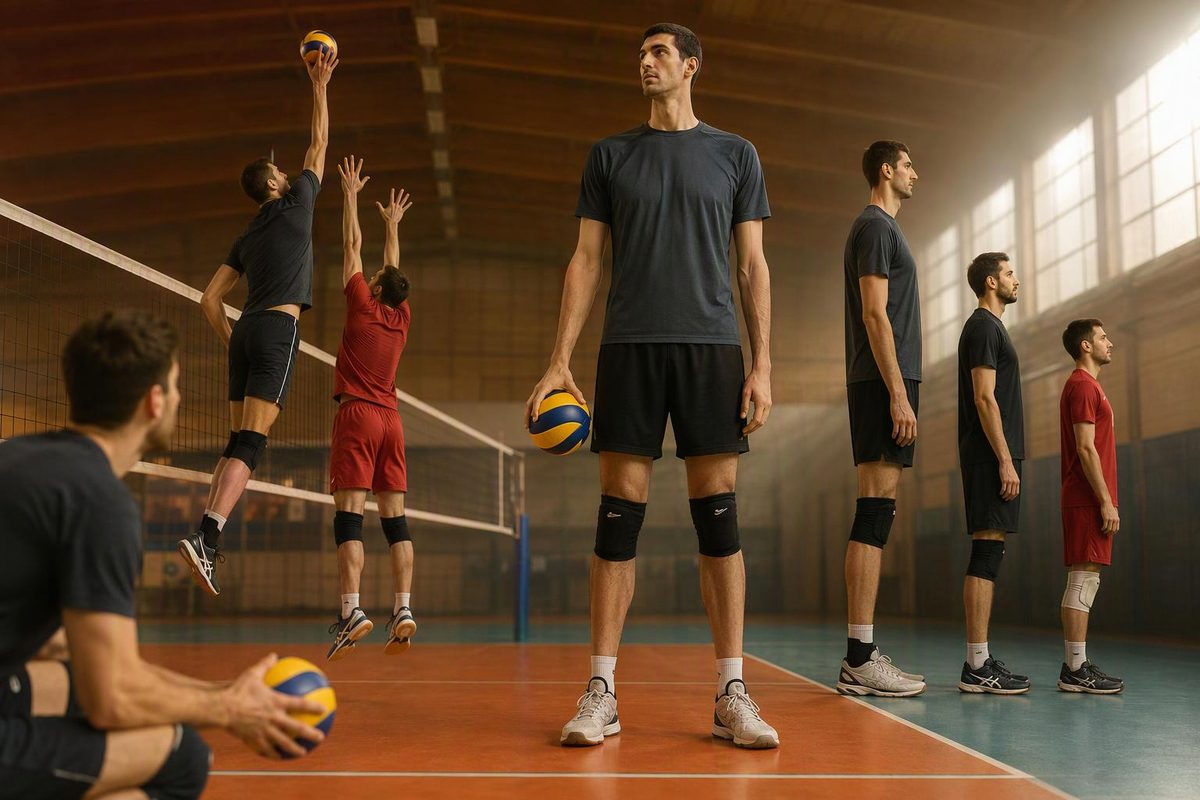
Compare Mehrzad’s 2.46 m height with standing indoor listings, see which records the sources support, and separate stature from reach and scoring impact.
Morteza Mehrzadselakjani of Iran is the best-supported answer to “tallest volleyball player” if sitting volleyball is included: 2.46 m, approximately 8 ft 1 in. Guinness World Records recognizes him as the tallest male athlete to compete at a Paralympic Games, recording that height at Rio 2016. The International Paralympic Committee also listed him at 2.46 m during Paris 2024. That is strong evidence for his stature, although the Guinness title is a Paralympic-athlete record, not a separate all-volleyball record. (Guinness record, IPC profile)
For standing indoor volleyball, the answer is less definitive. Volleybox lists Thailand’s Wutthichai Suksala at 2.24 m, but its community-maintained profile does not independently certify a worldwide height record. Dmitriy Muserskiy has an official competition listing of 2.18 m. That establishes his listed height, not a tallest-player title. Neither source settles who is the tallest active standing player worldwide. (Suksala profile, Muserskiy profile)
Choose a volleyball category to see the relevant height listings and what they establish.
Compare Height Claims by Category
Best-supported overall answer if sitting volleyball counts. Guinness recognizes a male Paralympic-athlete record, not an all-volleyball title.
| Player | Height | Category | Evidence |
|---|---|---|---|
| Morteza Mehrzadselakjani | 246 cm | Men’s sitting | RecordScopeGuinness: tallest male athlete to compete at a Paralympic Games, Rio 2016. IPC also lists 2.46 m for Paris 2024. |
| Wutthichai Suksala | 224 cm | Men’s standing | ReportedScopeVolleybox community profile. Career marked finished; not an independently certified world height record. |
| Dmitriy Muserskiy | 218 cm | Men’s standing | Official listingScopeVolleyball World’s 2025–26 SV.League player profile. A competition height listing, not a global tallest-player title. |
| Valeriya Kozlova | 6 ft 11 in ~211 cm | Women’s indoor | RosterScopeBarry University’s 2026 roster. Approximate metric conversion; not a universal women’s record. |
Sources: Guinness World Records, IPC, Volleybox, Volleyball World and Barry University; citations in the article.
The Height Listings Support Different Kinds of Answers
The names below are reference points, not a certified world ranking. Their sources differ both in authority and in what they claim: a record organization recognizes a specific record, an official roster lists a player’s height, and a community database reports a profile figure.
| Player | Context | Listed Height | Evidence Limit |
|---|---|---|---|
| Morteza Mehrzadselakjani | Men’s sitting | 246 cm; about 8 ft 1 in | Tallest male Paralympic athlete record |
| Wutthichai Suksala | Men’s standing indoor | 224 cm; about 7 ft 4 in | Community profile; career marked finished |
| Dmitriy Muserskiy | Men’s standing indoor | 218 cm; about 7 ft 2 in | Official competition listing |
| Valeriya Kozlova | Women’s indoor | 6 ft 11 in; about 211 cm | University roster listing |
Mehrzad represents Iran in men’s sitting volleyball. Suksala’s Volleybox profile lists him as a Thai standing indoor player and marks his playing career as finished. Muserskiy’s height comes from Volleyball World’s 2025–26 SV.League profile, which lists him as an opposite. Kozlova’s figure comes from Barry University’s 2026 roster.
The metric and imperial figures are rounded equivalents, not separate measurements. Kozlova’s roster figure is expressed as 6 ft 11 in; about 211 cm is its metric conversion. Likewise, “about 8 ft 1 in” makes Mehrzad’s 246 cm easier to picture without implying a more precise measurement than the source provides.
The evidence column matters as much as the height column. Sorting these four names by stature would identify the tallest person in this comparison. It would not establish that every eligible player worldwide had been checked, that all four were active in the same season, or that their heights had been measured under the same protocol.
Mehrzad’s Record Is Specific to Male Paralympic Athletes
Guinness provides the clearest record-based evidence in this comparison. Its title concerns the tallest male athlete to compete at a Paralympic Games. Mehrzad qualifies through sitting volleyball, and the recorded height is 2.46 m at Rio 2016.
The IPC’s Paris 2024 profile supplies a later listing of the same height. Those two sources support using 2.46 m when describing Mehrzad. They should not be rewritten as a claim that Guinness maintains a separate “tallest volleyball player” category or has certified a standing indoor record for him.
This distinction does not exclude him from the answer. The broad phrase “volleyball player” includes a sitting volleyball player unless the question specifies standing volleyball. It does mean the record should retain its actual name when cited.
A precise short answer is therefore: Mehrzad is the best-supported overall answer when sitting volleyball counts, and Guinness recognizes his male Paralympic-athlete height record. That wording gives the reader the name and height without extending the certification beyond its scope.
Standing Indoor Volleyball Has a Reported Leader Here, Not a Certified Winner
Suksala’s 224 cm is the largest standing indoor height among the listings presented here. The qualification is the source: Volleybox is a community-maintained player database. A profile can be useful evidence of a reported height without being an independent record adjudication.
Its career-status field also limits the answer. Because the profile marks Suksala’s career as finished, that listing should not be presented as proof that he is the tallest player currently competing. A historical player comparison and an active-player comparison are different searches.
Muserskiy’s 218 cm has a different evidentiary basis. Volleyball World’s 2025–26 SV.League competition profile is an official listing for that player in that competition. It supports the statement that he is listed at 218 cm there. It does not survey every league or certify that no taller standing player exists.
The two sources therefore cannot simply be treated as interchangeable entries in an official record table. Suksala has the higher reported figure; Muserskiy has the official competition listing. Neither fact erases the other, and neither establishes a universal standing-volleyball title.
If the intended question is “Who is the tallest active men’s standing indoor player?”, the evidence supplied here does not settle it. The missing evidence is a sufficiently comprehensive, current comparison—not another conversion of the same heights into feet and inches.
Kozlova’s Roster Height Does Not Establish a Women’s World Record
Barry University’s 2026 roster lists Valeriya Kozlova at 6 ft 11 in, approximately 211 cm. That is a concrete women’s indoor volleyball reference point from an official university source.
A university roster establishes how the university lists its player. It is not, by itself, a comparison of all women’s professional, collegiate and national-team players. Calling Kozlova the tallest woman in volleyball worldwide would require evidence beyond that roster entry.
The same distinction applies to the other names: an official source improves confidence in the listing, but “officially listed height” and “official world record” are not synonyms. A source can be authoritative about its own athlete without making a claim about every athlete elsewhere.
For the women’s category specifically, see our tallest women’s volleyball player guide. The figure retained here is Kozlova’s roster height, with the narrower claim that the cited source supports.
Height and Reach Describe Different Net Advantages
Height measures body stature. Block reach and spike reach describe how high the player can reach for those actions. They are more directly connected to play at the net, but the discipline must stay attached to the figures.
The IPC reports Mehrzad’s maximum block reach as 1.96 m and spike reach as 2.30 m. Men’s sitting volleyball uses a 1.15 m net, according to the World ParaVolley discipline guide. These are sitting-volleyball comparisons, not measurements against a standing indoor net.
Reach above the net equals listed reach minus net height: Mehrzad’s 196 cm block reach minus the 115 cm net is 81 cm, and his 230 cm spike reach minus that net is 115 cm.
| Measure | Listed Reach | Men’s Sitting Net | Above Net |
|---|---|---|---|
| Maximum block reach | 196 cm | 115 cm | 81 cm |
| Spike reach | 230 cm | 115 cm | 115 cm |
Those differences describe the relationship between the reported reach and the net. They are not guarantees that every block or attack contacts the ball at that height. A maximum reach figure does not provide a rally-by-rally record of contact position.
Nor should stature be substituted for reach. Subtracting the net height from Mehrzad’s 246 cm body height would answer a different, less useful question. The relevant comparison here uses the reported block and spike reaches, because those figures concern the volleyball actions themselves.
Comparable block and spike reach figures are not supplied for Suksala, Muserskiy or Kozlova in this comparison. Their height listings alone cannot produce a reliable reach ranking. The missing values remain unknown rather than being estimated from stature.
The Paris Final Shows Points Scored, Not a Height Effect
In the Paris 2024 men’s sitting volleyball final, Mehrzad scored 27 player points: 25 attack points and two service aces. Iran defeated Bosnia and Herzegovina 3–1, with set scores of 22–25, 30–28, 25–16 and 25–12, as reported by World ParaVolley.
| Set | Iran | Bosnia And Herzegovina | Winner |
|---|---|---|---|
| First | 22 | 25 | Bosnia And Herzegovina |
| Second | 30 | 28 | Iran |
| Third | 25 | 16 | Iran |
| Fourth | 25 | 12 | Iran |
These figures document a scoring performance in a specific match. They do not measure how many points his height caused. The report gives credited scoring actions; it does not supply a counterfactual showing what the result would have been with a shorter player.
The scoring breakdown also should not be mistaken for an efficiency statistic. Twenty-five attack points is an attack-scoring total. Without the corresponding attack attempts and errors, this evidence does not establish his kill percentage or attack efficiency for the match.
Similarly, a block reach of 1.96 m does not tell us how many block points he scored. Reach is a physical-action measurement; an attack point, service ace or block point is a recorded match outcome. Moving between those categories requires actual match data, not an assumption that the tallest athlete must lead each statistic.
The final is useful because it connects the height discussion to observed play while preserving that boundary. Mehrzad had a documented reach advantage relative to the sitting net and a documented scoring contribution. The sources do not isolate the share of that contribution attributable to stature.
Two Closing Rallies Explain Player Points Versus Scoreboard Points
The second set gives a compact example of why individual scoring totals differ from team totals. At 28–28, Mehrzad’s cross-court attack put Iran ahead 29–28. An opposing attack error then made the score 30–28, completing the required two-point lead.
Iran gained two scoreboard points across those rallies. Only the first was credited to Mehrzad as an attack point. The second moved the team score because of the opponent’s error, not because Mehrzad had produced another credited scoring action.
That distinction explains why his 27 player points should not be read as all the points Iran won while he was involved in play. A team’s scoreboard total includes points awarded through opposing errors as well as points credited to its own scorers.
It also keeps the physical and statistical claims separate. His stature describes the athlete. His reported reaches describe potential height at the net. His 25 attack points and two aces describe scoring actions credited in that final. The volleyball box score records outcomes; it does not turn a height listing into a measure of overall effectiveness.
The Defensible Answer Keeps the Category Attached
For a broad volleyball query, use Morteza Mehrzadselakjani, 2.46 m, and specify that he plays sitting volleyball. When describing the Guinness recognition, call it the tallest male Paralympic-athlete record.
For men’s standing indoor volleyball, Wutthichai Suksala is reported at 2.24 m by Volleybox, while Dmitriy Muserskiy is officially listed at 2.18 m in the 2025–26 SV.League profile. The supplied evidence does not certify a worldwide winner or resolve the active-player question.
For women’s indoor volleyball, Valeriya Kozlova is listed at 6 ft 11 in on Barry University’s 2026 roster. That is a supported player listing, not a universal women’s record. Keeping those qualifications attached gives a usable answer without turning four different sources into a record they never claimed to establish.