
Before You Count a Sub, Check Which Rulebook Applies
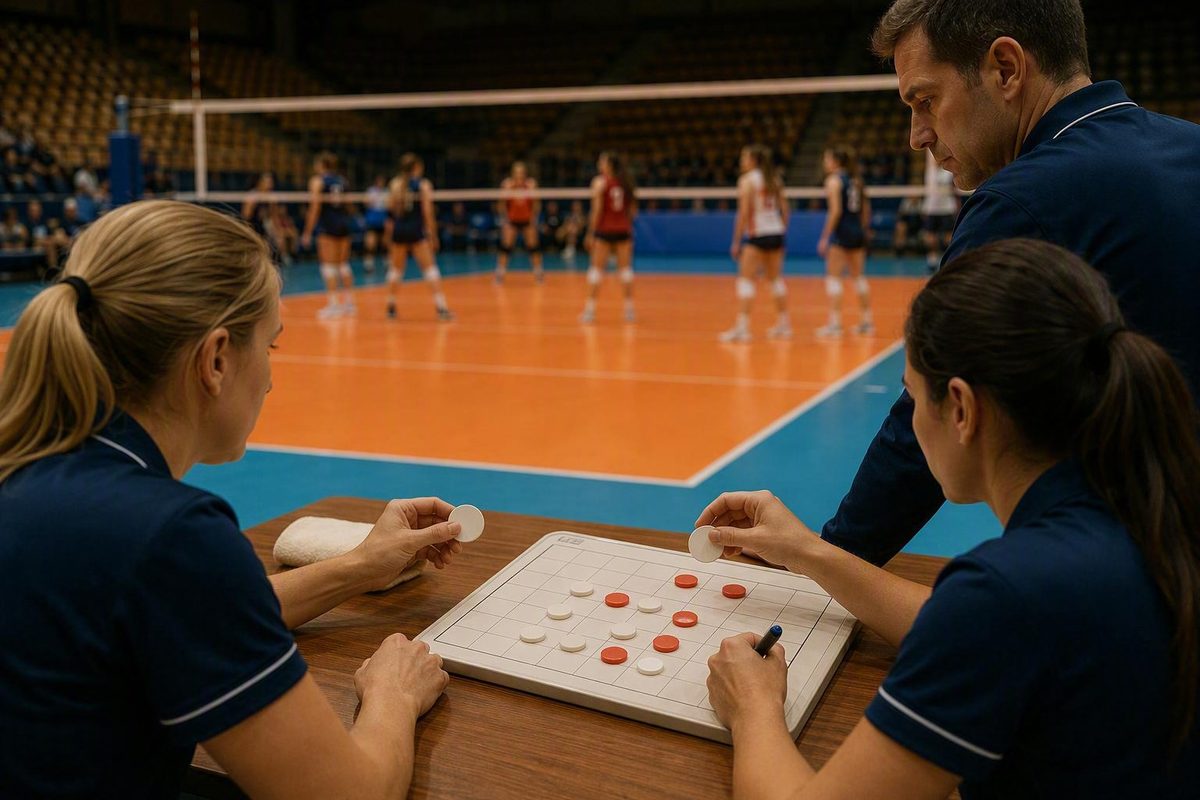
Identify the controlling code, separate regular subs from libero replacements, count each charged exchange, and verify re-entry and scorer records.
Volleyball does not have one universal substitution system. Before counting an exchange, identify the match format, governing body, competition level, rulebook edition and any event modifications. In indoor volleyball, also distinguish charged regular substitutions from libero replacements, which are administered separately. This is an indoor-volleyball guide to the FIVB-style counting model, entry zones and scorekeeping—not a beach-volleyball replacement guide or a complete comparison of every domestic code.
The short answer: substitution rules depend on the competition
Use this five-part checklist before applying any substitution rule:
- Format: Is the match indoor or beach volleyball?
- Governing body: Does FIVB, USA Volleyball, NCAA, NFHS or another organization control it?
- Competition level: Is it international, collegiate, school, club or recreational play?
- Rulebook season: Which edition is in force?
- Event modifications: Has the tournament or league issued additional regulations?
Until those questions are answered, no figure—whether six, twelve or fifteen substitutions per set—can safely be applied to every volleyball match.
For international indoor play, the FIVB’s current edition is the Official Volleyball Rules 2025–2028. It was approved in 2024 and applies to competitions beginning after January 1, 2025. Substitution provisions appear in Chapter 5, while libero provisions appear in Chapter 6 of the FIVB Official Volleyball Rules 2025–2028.
| Match type | Documents to consult | What they determine |
|---|---|---|
| FIVB indoor competition | Current FIVB rules and event regulations | International rules, court zones and event modifications |
| USA Volleyball indoor competition | Current playing rules, event regulations and scoring instructions | Legal substitutions and how the scorer records them |
| Local or recreational league | Current league rules | That league’s limits, rotation system and penalties |
| Beach volleyball | Current beach rules and event regulations | Beach-specific replacement procedures |
A familiar court layout or scoresheet does not identify the controlling code. Confirm the competition documents before relying on a limit, re-entry right, exception or penalty.
Regular substitutions and libero replacements are different events
A regular substitution is a player-for-player exchange between rallies. A player from the bench enters for an outgoing player and takes that player’s place in the rotation order. The person changes; the rotational position does not.
A libero replacement is a different type of lineup change. The FIVB rulebook reflects that distinction by placing regular interruptions and substitutions in Chapter 5, libero provisions in Chapter 6, and the two forms of entry in separate court areas.
Explanatory guides describing the FIVB system say libero replacements do not consume the regular-substitution allowance. They also describe the libero as replacing a back-row player between points rather than entering through an ordinary charged substitution.
That distinction explains why the visible movement at the sideline may not match the substitution total. A libero can move in and out repeatedly, creating numerous lineup changes while the scorer records far fewer regular substitutions. Counting every player who crosses the sideline as “one sub” will therefore overstate the charged total.
This distinction should not be extended to code-dependent questions such as libero serving or redesignation. Those provisions must be taken from the rules governing the specific match.
How FIVB-style substitution counting and re-entry work
A third-party guide describing the 2025 FIVB system reports a maximum of six regular substitutions per team per set. It also says every player-for-player exchange counts separately: removing a starter uses one substitution, and returning that starter later uses another (Judgemate’s FIVB substitution guide).
Consider one sequence:
- Starter No. 7 begins on court.
- Substitute No. 12 replaces No. 7: substitution one.
- No. 7 later returns for No. 12: substitution two.
The complete out-and-back sequence therefore uses two charged exchanges, not one.
The same guide describes a fixed-pair re-entry model. A starter returns to the original rotation position and replaces the same substitute who entered for that starter. The rotation slot remains fixed even though the player occupying it changes.
Under that model, this later sequence would be illegal:
- No. 12 replaces starter No. 7.
- The team later attempts to send No. 12 in for starter No. 4.
- No. 12 has already been paired with No. 7 and cannot be reassigned to No. 4 during that set.
Because the six-substitution figure and fixed-pair explanation above come from a third-party interpretation, the official FIVB rules and competition regulations remain controlling for match administration. The model must not be transferred automatically to NCAA, NFHS, USA Volleyball or recreational competition, where substitution limits and re-entry rights may differ.
Where and when a substitution happens
A regular substitution is processed between rallies, while the ball is out of play. The incoming player enters through the designated substitution area near the scorer’s table so the exchange can be authorized and recorded.
Under FIVB Rule 1.4.3, the substitution zone is bounded by the extensions of the two attack lines and extends to the scorer’s table. Rule 1.4.4 places the libero replacement zone on the bench side of the free zone, between the attack-line extension and the end line (FIVB court-zone definitions).
In practical terms, the areas are arranged like this:
- The regular substitution zone is beside the court and aligned with the space between the attack-line extensions.
- The scorer’s table sits beyond that zone.
- The libero replacement zone is farther toward the end line on the bench side.
- The net, center line and attack lines provide the main reference points separating the areas.
The physical separation mirrors the administrative distinction. A regular substitute does not simply enter through the libero replacement area, and a libero movement is not converted into a regular substitution merely because both occur between rallies.
The FIVB-oriented explanatory guide also says a team may make multiple exchanges during one stoppage. Those exchanges do not merge into one substitution. If two incoming players replace two outgoing players during the same dead ball, the scorer counts and records two player-for-player exchanges under the model described.
What the scorer records when a player changes
The indoor scorer tracks the score, substitutions and other match events. USA Volleyball publishes scoresheets and lineup materials for regular match administration as well as separate libero-control forms.
USA Volleyball’s official scoresheet contains fields labeled “Score at Substitution.” When both teams’ scores must be entered, the score of the team causing the substitution is written first under the USA Volleyball Scoring Instructions.
Suppose Team A causes a substitution while leading 18–16. The scorer records Team A’s score first. This convention lets an official reviewing the scoresheet determine which team initiated the action and when the lineup change occurred.
The record can therefore help reconstruct a set by showing when substitutions occurred within the scoring sequence. It is both an administrative record and a lineup history, not merely a running count.
The displayed USA Volleyball scoresheet has numbered substitution fields from 1 through 15. Those spaces do not independently prove that every USA Volleyball event permits fifteen substitutions per set. A scoresheet is designed to record events; the legal allowance comes from the controlling playing rules and event regulations.
Regular substitutions appear on the scoresheet, while USA Volleyball also supplies libero-control materials. That establishes separate recordkeeping resources without implying that the scoring documents alone contain every rule governing libero replacements.
Why coaches substitute—and why local rules can look different
Substitution strategy begins with a tactical objective but remains limited by the rulebook. A coach may identify the ideal player for the next rotation, yet the exchange must still satisfy the applicable limit, re-entry conditions and rotation requirements.
Common tactical uses include:
- introducing a serving specialist for a targeted service run;
- improving the block against a particular front-row matchup;
- replacing a front-row attacker with a stronger back-row passer or defender;
- changing a matchup late in a set;
- using a defensive specialist without assigning that player the libero role.
A defensive specialist who enters through an ordinary player-for-player exchange is treated as a regular substitute in the FIVB-oriented guide. That differs from a libero replacement even when the tactical purpose—improving back-row defense—is similar. The player’s designation and entry procedure, not the coaching label, determine how the exchange is administered.
Local competitions can adopt substantially different systems. For example, FXA Sports’ volleyball rules allow a team to choose before a set between unlimited player-for-player positional substitution and continuous rotation. The chosen method must be retained for that set. FXA also specifies its own consequence for an illegal substitution: loss of the rally, a point for the opponent and correction of the lineup.
Those are FXA competition rules, not general FIVB, NCAA, NFHS or USA Volleyball provisions. Before relying on any substitution rule, confirm:
- the current controlling rulebook and event regulations;
- the regular-substitution limit;
- who may re-enter and for whom;
- whether a player pairing or rotation position must be preserved;
- whether an injury creates an exception;
- how an illegal exchange is corrected or penalized.
The practical sequence is to identify the code, separate regular substitutions from libero replacements, count each charged exchange individually, preserve any required pairing or rotation position, and check the scorer’s record. Exact limits, re-entry rights, exceptions and penalties always come from the rules for the specific competition.