
Yes, You Can Kick the Ball in Volleyball—But Not to Serve
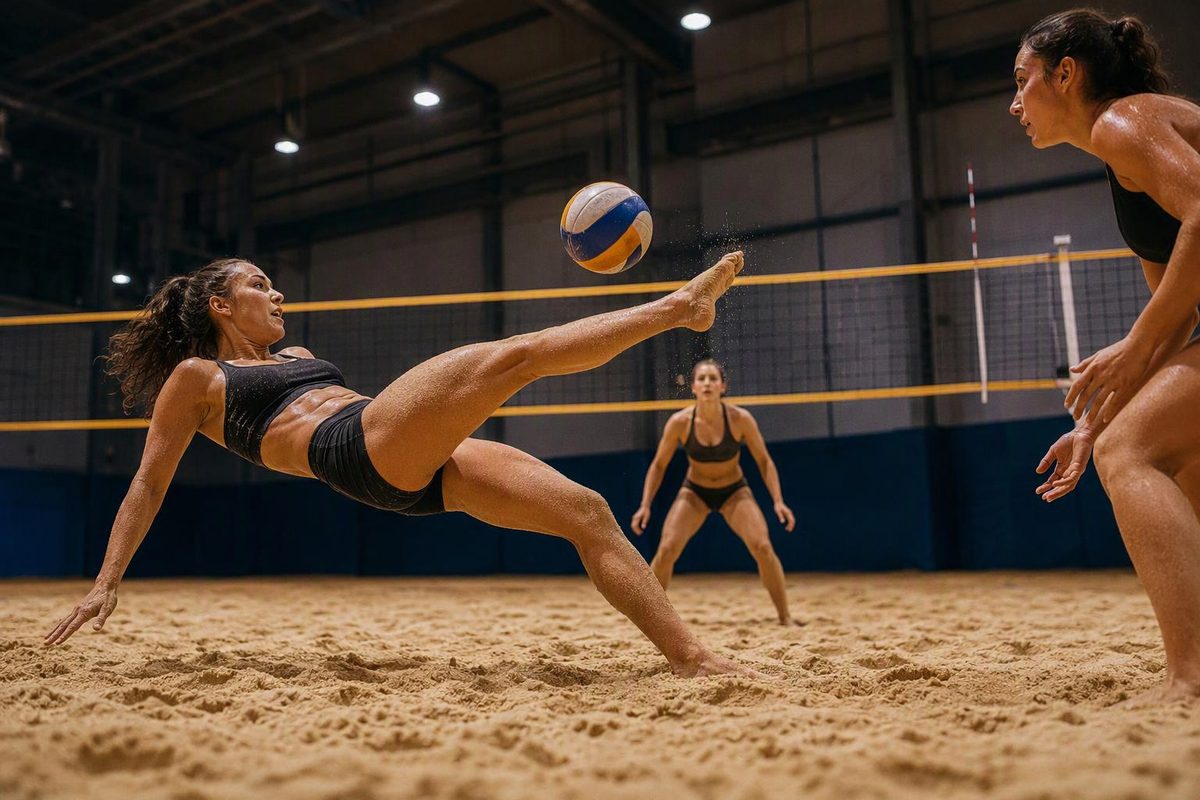
Kicking the ball is legal in indoor and beach volleyball during a rally. It counts as a team hit, but the serve must be struck with a hand or arm.
Yes. You can legally kick the ball during a volleyball rally. Under the current FIVB indoor rules, the ball may touch any part of the body. USA Volleyball gives the same plain-language guidance. A foot save is therefore legal whether the contact is deliberate or accidental; using a foot or leg does not by itself create a fault (FIVB Official Volleyball Rules 2025–2028, Rule 9.2.1; USA Volleyball rules overview).
There is one important exception: you cannot kick the ball to serve. The server must strike it with one hand or any part of an arm after tossing or releasing it. That requirement appears in both the FIVB indoor and beach rules (FIVB indoor rules, Rule 12.4.1; FIVB beach rules, Rule 12.4.1).
What a kick counts as
A legal kick counts as one team contact, just like a forearm pass, set or attack. In indoor volleyball, a team normally has no more than three hits to return the ball. A block contact is excluded from that count under FIVB indoor rules.
Consider this rally at 18–18:
| Action | Team contact | Ruling |
|---|---|---|
| Defender kicks up an opponent’s attack | 1 | Legal |
| Setter sends the ball to a hitter | 2 | Legal |
| Hitter attacks over the net | 3 | Legal |
If the kick itself sends the ball over the net through the crossing space, that can also be legal. A team does not have to use all three contacts. If the kicked ball lands in the opponent’s court, the kicking team wins the rally and a point under rally scoring. If it lands out without an opponent’s touch, the other team wins the rally.
Permission to use a foot does not override the usual ball-handling rules. The ball must rebound rather than be caught or thrown, a team cannot exceed its permitted contacts, and a player generally cannot make two separate consecutive contacts. The FIVB indoor rules set out these requirements and their exceptions in Rules 9.1–9.3.
Indoor and beach volleyball
The basic answer is the same in both disciplines: feet and legs are legal contact surfaces. The FIVB beach rules say that the ball may touch any part of the body (Rule 9.2.1).
One related counting rule differs:
- Indoor: A block touch does not count as one of the team’s three hits, so the team still has three contacts after the block (Rule 14.4.1).
- Beach: A block touch counts as the first team hit, leaving only two more contacts (Rule 14.4.1).
That distinction matters in a scramble. After an indoor block, a foot save can be the first of three team hits. After a beach block, the same foot save is already the second team hit, leaving only one contact to return the ball.
Beach volleyball also has stricter provisions for some hand contacts, but those do not make foot contact illegal. The general limit remains three team hits.
When a kick becomes a fault
The body part is usually not the problem. The surrounding action can still make the play illegal:
- Kicking the serve: The serve must be struck with a hand or arm.
- Four team hits: A kick is a fault if it is the team’s fourth contact.
- Two separate contacts by one player: This is generally a double-contact fault unless a stated exception applies.
- Caught or thrown ball: A player cannot trap, hold or throw the ball instead of allowing it to rebound.
- Another violation during the play: For example, a player can still commit a fault by interfering with an opponent, sending the ball out or touching the net between the antennae during the action of playing the ball.
USA Volleyball’s youth guidance makes the practical distinction explicit: the ball may rebound from any body surface, so “kicking up a save” is allowed, but a player may not kick the ball for service (USA Volleyball simplified youth rules).
Competition rules can vary by governing body, discipline or local league, so modified recreational formats should be checked separately. Under the cited FIVB indoor and beach rules, however, a kick during a rally is legal.