
West Germany in Volleyball: 1972 Results and Old Scores
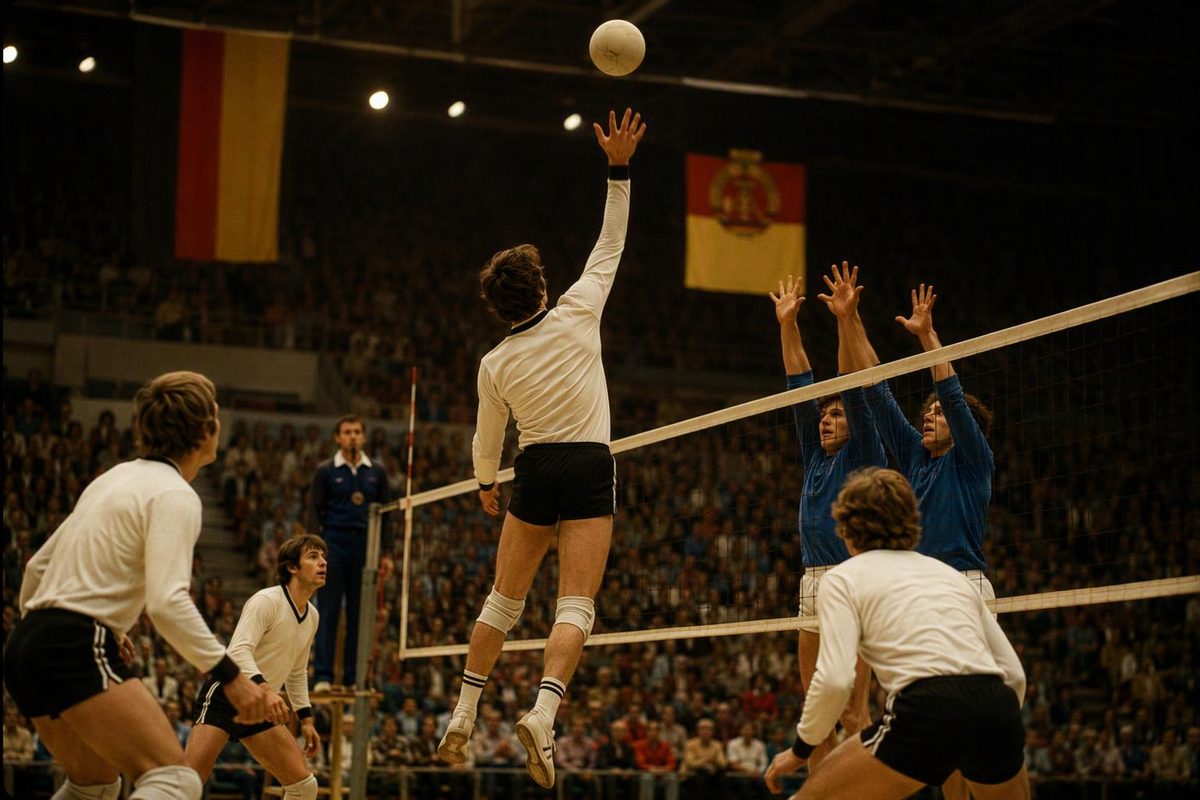
Identify West Germany (FRG) in volleyball records, separate it from East Germany, and read Munich 1972 set scores under the old scoring system.
West Germany was the historical name used for the Federal Republic of Germany, listed as FRG in Munich 1972 volleyball records. It fielded a separate team from East Germany—the German Democratic Republic, listed as GDR. That distinction matters: West Germany finished 11th in men’s volleyball and eighth in women’s volleyball at those Olympics; the men’s silver medal belonged to East Germany, not the host team. Olympedia’s West German results and the official men’s standings distinguish the two entries.
The historical names reflect Germany’s division before reunification on 3 October 1990. When reading an older result, preserve its country label rather than treating FRG and GDR as interchangeable versions of “Germany.” Germany’s Federal Government explains the reunification date.
What happened at Munich 1972?
Both West German indoor teams entered as representatives of the host nation. The men lost all five pool matches, then beat Tunisia 3–1 in the 11th-place match, finishing with one win and five losses. They also faced East Germany in pool play on 3 September, losing 0–3. Olympedia’s men’s tournament record lists the qualification routes and match results.
The women lost all five matches without winning a set: three pool matches, a classification match against Cuba, and the seventh-place match against Czechoslovakia. Their tournament record was therefore 0–5 in matches and 0–15 in sets. These are different counts: one straight-sets defeat adds one match loss but three set losses. The women’s tournament results show each defeat.
A West German score, decoded
In the women’s seventh-place match on 7 September 1972, Czechoslovakia beat West Germany 3–0, with set scores of 15–13, 15–4 and 16–14. The match score counts sets won; the individual set scores count scoreboard points. The match record also lists a duration of 74 minutes.
Here is the same result with West Germany’s points first:
| Set | West Germany | Czechoslovakia | Winning margin |
|---|---|---|---|
| 1 | 13 | 15 | 2 points |
| 2 | 4 | 15 | 11 points |
| 3 | 14 | 16 | 2 points |
| Total | 31 | 46 | 15 points overall |
The sweep contained two sets decided by two points and one much wider set. “0–3” alone does not reveal that pattern. Nor did the 31–46 aggregate decide the match: Czechoslovakia won because it won three sets.
Why the sets ended at 15, not 25
These were side-out scoring results. Under the old system, only the serving team could score a point. A receiving team that won a rally gained the serve without adding a scoreboard point. Sets were played to 15 rather than today’s usual 25-point target for the first four indoor sets. FIVB’s scoring overview describes both systems.
The 16–14 third set illustrates the two-point margin: 15–14 was not enough to finish it. But its 30 recorded points do not mean that only 30 rallies occurred—service changes could leave the score unchanged.
Across the match, West Germany scored 31 of the 77 recorded points, approximately 40.3%. That is its share of scoreboard points, not its share of rallies won. Recovering the latter would require rally-by-rally information, not just these set totals.
For a modern comparison, see how volleyball scoring works: rally scoring awards a point on every rally, so point totals and rally counts have a different relationship.