
The 1896 Volleyball Demonstration: Who Played and What Is Recorded
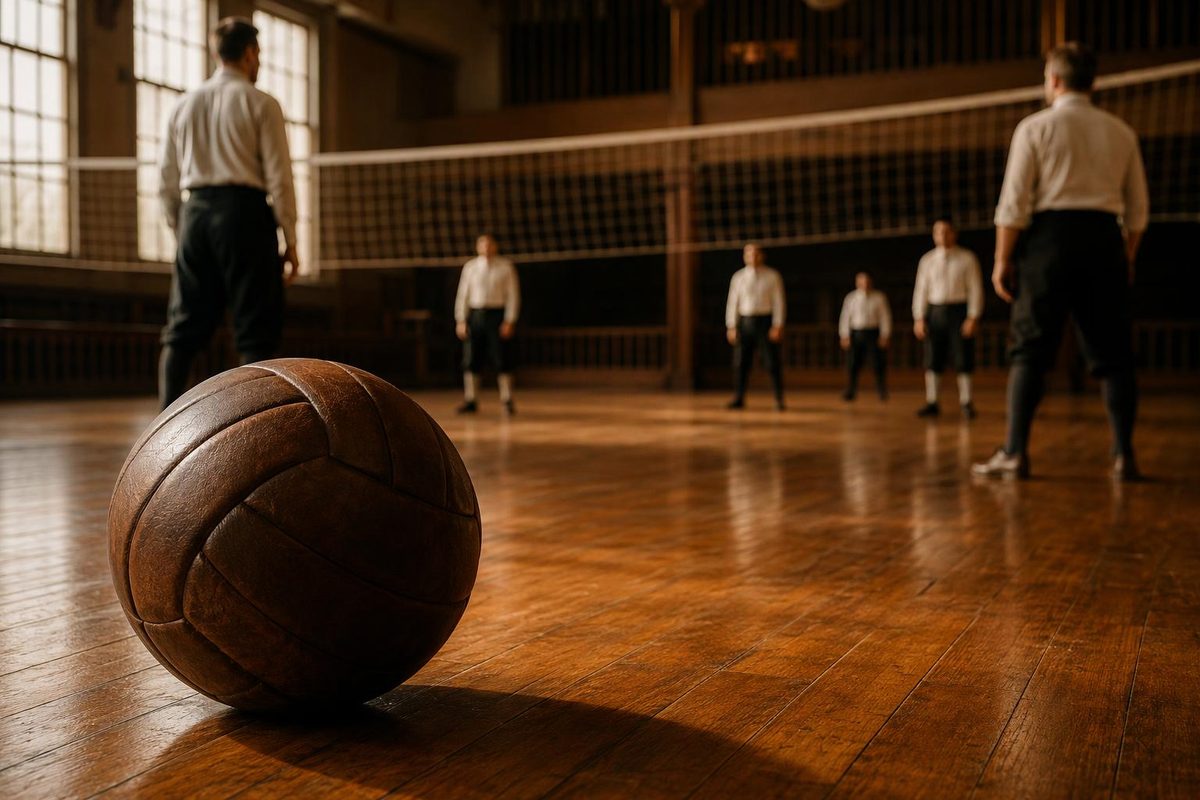
The 1896 Springfield demonstration featured two five-man teams. Learn who captained them, why “first” needs care, and what is known about the result.
An early documented volleyball match was William G. Morgan’s demonstration at the YMCA training school now known as Springfield College, in Springfield, Massachusetts. The International Volleyball Hall of Fame dates it to July 7, 1896. Calling it the first volleyball match needs a qualification: it was a demonstration of a game Morgan had already developed, not necessarily the first time anyone played it.
Two teams of five men took part. Their captains are identified, but neither the Hall of Fame’s account nor the FIVB’s history reports a winner or final score. It is best understood as an early exhibition of the new game, not a championship fixture with a documented result.
Who played in the demonstration?
Morgan brought the teams from Holyoke to demonstrate the sport to a conference of YMCA physical education directors. The captains were:
- James J. Curran, then mayor of Holyoke.
- John Lynch, chief of the Holyoke fire department.
The FIVB’s account places the demonstration in the college’s east gymnasium and confirms five men on each side. These histories identify the captains rather than providing a complete ten-player roster.
That distinction matters: this was not Springfield College versus another college, nor a match between national teams. Morgan had assembled two sides to show other physical educators how his game worked.
Was it really the first game ever played?
“Early public demonstration” is a more careful description than “first time anyone played volleyball.” Morgan had already developed the game at the Holyoke YMCA in 1895. The FIVB describes his earlier experiments with the net, ball and rules before the Springfield exhibition.
The accounts also differ on timing. The Hall of Fame gives July 7, 1896; the FIVB places the conference “early in 1896” without supplying a day. The exact July date should therefore be attributed to the Hall of Fame, rather than presented as confirmed by both accounts.
What can we say about the score?
There is no score to quote from those two institutional histories. They document the demonstration and its participants, but do not establish which captain’s team won, how many points were scored, or whether a complete game was finished.
Nor should a modern set score be reconstructed. The Hall of Fame describes the early game as divided into nine innings, with unlimited players and unlimited contacts permitted. Nine innings meant divisions within a game—not nine modern volleyball sets. The demonstration’s five-player teams were a choice for that exhibition, not a universal team-size limit.
For comparison, a modern indoor result such as 3–0 records sets won, not total points; our guide to how volleyball scoring works explains that notation. Assigning such a result to the 1896 demonstration would invent a score and impose a later format on the event.